
Isolation Precautions and Personal Protective Equipment (PPE)
Comprehensive Nursing Education Notes
Estimated Reading Time: 25-30 minutes
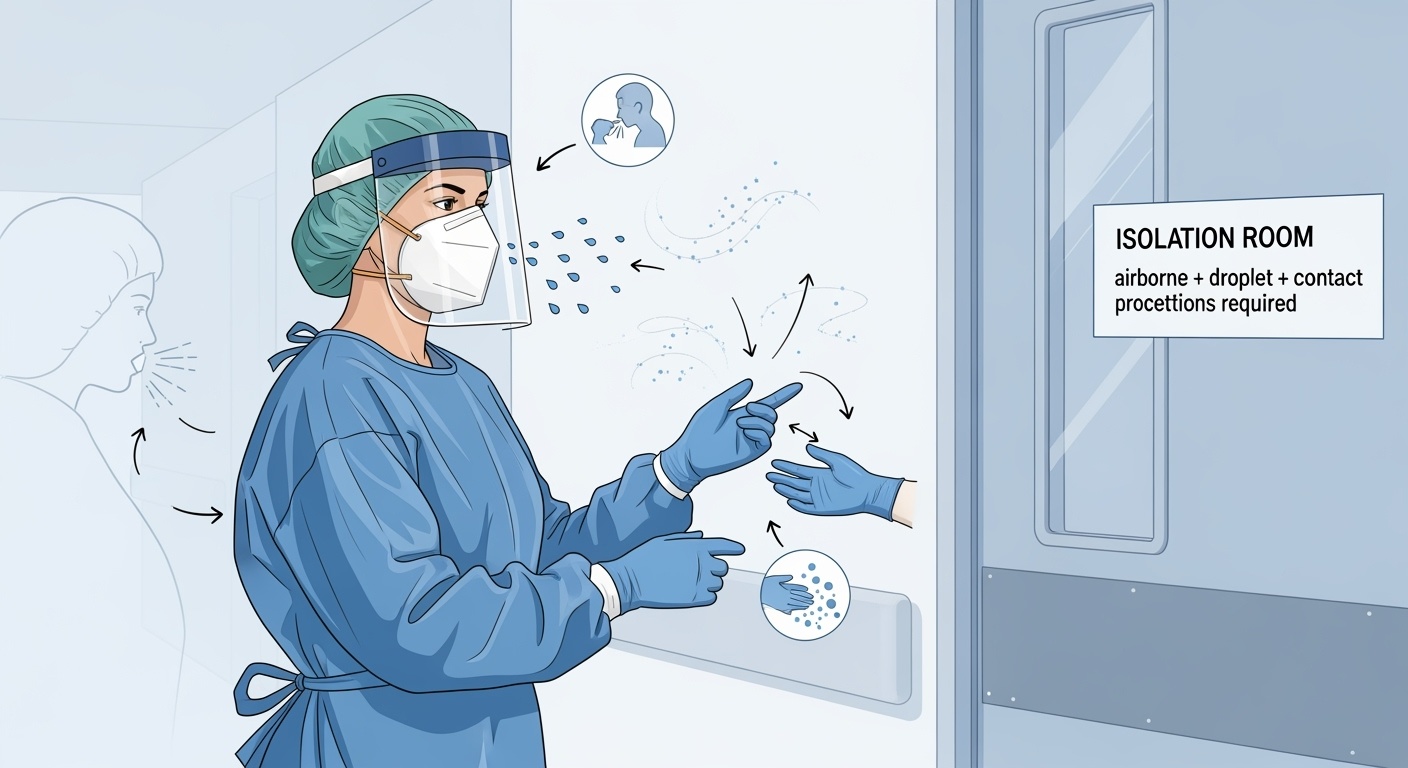
Professional healthcare illustration showing proper PPE usage and isolation precautions
Table of Contents
Introduction to Infection Prevention
Memory Aid: “SHIELD” Framework
- Standard precautions for all patients
- Hand hygiene as first defense
- Isolation when needed
- Equipment protection (PPE)
- Level of precaution based on transmission
- Ddocumentation and compliance
Healthcare-associated infections (HAIs) affect millions of patients annually, making infection prevention and control fundamental to safe nursing practice. The implementation of proper isolation precautions and personal protective equipment (PPE) serves as the cornerstone of infection prevention strategies in healthcare settings.
Critical Statistics
- HAIs affect 1 in 31 hospital patients on any given day
- Proper PPE use can reduce transmission by up to 90%
- Hand hygiene compliance reduces infections by 40-50%
- Cost of HAIs exceeds $28 billion annually in the US
The evolution of infection control practices has been shaped by historical pandemics, scientific discoveries, and the emergence of multidrug-resistant organisms. Modern infection prevention strategies are built on the foundation of understanding pathogen transmission routes and implementing evidence-based interventions.
Nursing’s Role in Infection Prevention
Nurses serve as the primary guardians of infection prevention, spending the most direct time with patients and having the greatest opportunity to implement and monitor infection control measures. This responsibility requires comprehensive knowledge of isolation precautions, proper PPE usage, and the ability to educate both patients and healthcare team members.
Types of Isolation Systems
Isolation systems are structured approaches to preventing the transmission of infectious agents in healthcare settings. These systems have evolved from simple quarantine measures to sophisticated, evidence-based protocols that balance infection control with patient care quality.
Mnemonic: “CATS” for Isolation Categories
- Contact – Direct and indirect contact transmission
- Airborne – Respiratory droplet nuclei
- Transmission-based – Specific pathogen requirements
- Standard – Universal precautions for all patients
Historical Development of Isolation Systems
The concept of isolation has ancient roots, with historical records of quarantine practices dating back to the 14th century during the Black Death. Modern isolation systems began developing in the 1950s with the recognition of specific transmission routes and the need for standardized approaches.
Evolution of Isolation Systems
Historical Quarantine
(14th Century)
Category-Specific
(1950s-1980s)
Universal Precautions
(1985)
Standard + Transmission-Based
(1996-Present)
Modern Isolation Classification
Standard Precautions
Applied to all patients regardless of suspected or confirmed infection status, based on the principle that all patients may harbor transmissible infectious agents.
- Hand hygiene before and after patient contact
- Use of PPE based on anticipated exposure
- Safe injection practices
- Environmental cleaning and disinfection
Contact Precautions
Implemented for patients with known or suspected infections transmitted by direct or indirect contact with the patient or contaminated surfaces.
- Private room or cohorting with same pathogen
- Gowns and gloves for all patient contact
- Dedicated patient care equipment
- Enhanced environmental cleaning
Droplet Precautions
Used for patients with known or suspected infections transmitted by respiratory droplets larger than 5 micrometers.
- Private room or cohorting with same pathogen
- Surgical mask within 3 feet of patient
- Patient mask during transport
- Standard room air handling
Airborne Precautions
Required for patients with known or suspected infections transmitted by airborne droplet nuclei smaller than 5 micrometers.
- Negative pressure room with HEPA filtration
- N95 respirator or higher level protection
- Fit testing for respiratory protection
- Specialized air handling systems
Clinical Pearl: Combination Precautions
Some pathogens require multiple precaution types. For example, varicella-zoster virus requires both contact and airborne precautions due to its multiple transmission routes. Always consult current infection control guidelines for specific organisms.
Room Requirements and Infrastructure
Proper isolation requires appropriate physical infrastructure. Understanding room requirements helps nurses advocate for appropriate patient placement and recognize when isolation protocols may be compromised.
| Isolation Type | Room Requirements | Air Changes/Hour | Door Status |
|---|---|---|---|
| Standard | Private room preferred | Standard (6-12) | May remain open |
| Contact | Private room or cohorting | Standard (6-12) | May remain open |
| Droplet | Private room or cohorting | Standard (6-12) | Closed preferred |
| Airborne | Negative pressure room | ≥12 with HEPA | Closed at all times |
Standard Precautions
Standard precautions represent the fundamental infection prevention practices that must be used in the care of all patients, regardless of their suspected or confirmed infection status. These precautions are based on the principle that all patients may harbor transmissible infectious agents in their blood, body fluids, secretions, excretions, non-intact skin, and mucous membranes.
Memory Aid: “HANDS CLEAN” for Standard Precautions
- Hand hygiene – Primary defense mechanism
- Appropriate PPE use
- Needle safety and sharps management
- Disinfection of equipment and environment
- Safe injection practices
- Cleaning and sterilization protocols
- Linen handling procedures
- Environmental controls
- Airway management safety
- Notification and reporting systems
Core Components of Standard Precautions
Hand Hygiene
The single most effective measure for preventing transmission of infectious agents.
- Before patient contact
- Before aseptic procedures
- After body fluid exposure risk
- After patient contact
- After contact with patient surroundings
PPE Selection
Choose appropriate PPE based on anticipated exposure to infectious materials.
- Gloves for potential blood/body fluid contact
- Gowns for extensive contact
- Masks for splash/spray protection
- Eye protection for mucous membrane exposure
Detailed Hand Hygiene Protocols
WHO 5 Moments for Hand Hygiene
Before Patient Contact
Protect patient from harmful germs on hands
Before Aseptic Procedure
Protect patient from harmful germs
After Body Fluid Risk
Protect yourself and healthcare environment
After Patient Contact
Protect yourself and healthcare environment
After Patient Environment
Protect yourself and healthcare environment
Proper Handwashing Technique
- Wet hands with clean running water
- Apply soap and lather thoroughly
- Rub hands together for at least 20 seconds
- Clean between fingers and under nails
- Rinse thoroughly with clean water
- Dry with clean towel or air dry
- Use towel to turn off faucet
Alcohol-Based Hand Rub
- Apply product to palm of one hand
- Rub hands together covering all surfaces
- Continue until hands are dry (20-30 seconds)
- Ensure coverage of fingertips and thumbs
- Allow complete drying before patient contact
- Use only when hands are not visibly soiled
Safe Injection Practices
Safe injection practices are fundamental to preventing transmission of bloodborne pathogens and ensuring patient safety during invasive procedures.
Never Events in Injection Safety
- Reusing needles or syringes on multiple patients
- Using single-dose vials for multiple patients
- Accessing IV bags or bottles with contaminated needles
- Failing to use aseptic technique for vial access
- Reusing injection equipment without proper sterilization
Needle Safety Principles
- Use safety-engineered devices when available
- Never recap needles using two hands
- Dispose of sharps immediately after use
- Use appropriate sharps containers
- Report all needlestick injuries immediately
Vial Access Safety
- Disinfect vial tops before each access
- Use new needle and syringe for each access
- Single-dose vials for one patient only
- Multi-dose vials require strict aseptic technique
- Date and discard vials per manufacturer guidelines
Environmental Cleaning and Disinfection
Environmental surfaces play a crucial role in pathogen transmission. Proper cleaning and disinfection protocols are essential components of standard precautions.
| Surface Type | Cleaning Frequency | Disinfectant Level | Contact Time |
|---|---|---|---|
| High-touch surfaces | Between patients | EPA-registered | Per label instructions |
| Non-critical equipment | After each use | Low-level disinfectant | 1-10 minutes |
| Blood spills | Immediately | 1:10 bleach solution | 10 minutes |
| Patient rooms | Daily and discharge | Hospital-grade | Per manufacturer |
Nursing Implementation of Standard Precautions
Successful implementation of standard precautions requires consistent application across all patient encounters. Nurses must serve as role models and educators for other healthcare team members.
- Conduct regular competency assessments for hand hygiene
- Monitor PPE compliance and provide immediate feedback
- Participate in infection prevention surveillance activities
- Educate patients and families about infection prevention
- Report breaches in standard precautions immediately
Transmission-Based Precautions
Transmission-based precautions are additional infection prevention measures used for patients known or suspected to be infected with pathogens that require precautions beyond standard precautions. These precautions are designed to interrupt specific routes of transmission and are used in addition to, not instead of, standard precautions.
Mnemonic: “CLAD” for Transmission Routes
- Contact – Direct skin-to-skin or indirect via contaminated surfaces
- Large droplets – Respiratory droplets >5 micrometers
- Airborne – Droplet nuclei <5 micrometers
- Distance matters – Different precautions for different transmission distances
Contact Precautions
Contact precautions are the most frequently used transmission-based precautions, designed to prevent transmission of infectious agents through direct or indirect contact. These precautions are essential for managing multidrug-resistant organisms and other highly transmissible pathogens.
Direct Contact Transmission
Direct contact transmission occurs when infectious agents are transferred through physical contact between an infected or colonized person and a susceptible host. This includes patient-to-patient contact and contact with healthcare workers’ hands or clothing.
Examples of Direct Contact Pathogens:
- Methicillin-resistant Staphylococcus aureus (MRSA)
- Vancomycin-resistant Enterococci (VRE)
- Clostridium difficile
- Scabies
- Impetigo
- Pediculosis
Prevention Strategies:
- Gowns and gloves for all patient contact
- Dedicated stethoscopes and equipment
- Enhanced hand hygiene
- Private room or cohorting
- Visitor education and restrictions
Indirect Contact Transmission
Indirect contact transmission occurs when infectious agents are transferred through contaminated intermediate objects or surfaces. This includes medical equipment, environmental surfaces, and the hands of healthcare workers.
Chain of Indirect Contact Transmission
Infected Patient
Contaminated Surface
Healthcare Worker
Susceptible Patient
Droplet Precautions
Droplet precautions are used for patients with known or suspected infection with pathogens transmitted by respiratory droplets larger than 5 micrometers. These droplets are generated during coughing, sneezing, talking, or certain medical procedures.
Droplet Transmission Characteristics
Physical Properties:
- Particle size: >5 micrometers
- Travel distance: Usually ≤3 feet
- Settling time: Relatively rapid
- Survival on surfaces: Variable
Common Pathogens:
- Influenza virus
- Streptococcus pneumoniae
- Neisseria meningitidis
- Bordetella pertussis
- Adenovirus
- Respiratory syncytial virus (RSV)
Droplet Precaution Requirements
- Surgical mask when within 3 feet of patient
- Patient placement in private room or cohorted with same organism
- Patient wears mask during transport
- Standard air handling adequate (no negative pressure required)
- Hand hygiene before and after patient contact
Airborne Precautions
Airborne precautions are the most stringent transmission-based precautions, used for patients with known or suspected infection with pathogens transmitted by airborne droplet nuclei smaller than 5 micrometers. These particles can remain suspended in air for extended periods and travel long distances.
Airborne Transmission Characteristics
Physical Properties:
- Particle size: <5 micrometers
- Travel distance: >3 feet (potentially entire building)
- Suspension time: Hours to days
- Environmental persistence: Extended
Key Pathogens:
- Mycobacterium tuberculosis
- Varicella-zoster virus
- Rubeola (measles)
- SARS-CoV-2 (certain procedures)
- Aspergillus species
Critical Airborne Precaution Requirements
- Negative pressure room with ≥12 air changes per hour
- Air exhausted directly outside or HEPA filtered
- N95 respirator or higher level protection
- Annual fit testing for all staff
- Room door kept closed at all times
- Minimize number of healthcare workers entering room
Respiratory Protection Hierarchy
Surgical Mask
Droplet precautions
N95 Respirator
Airborne precautions
PAPR
High-risk procedures
Full Face Shield
Maximum protection
Special Situations and Combinations
Some pathogens require multiple transmission-based precautions due to their ability to spread through different routes. Understanding these combinations is crucial for effective infection prevention.
| Pathogen | Transmission Route(s) | Required Precautions | Duration |
|---|---|---|---|
| Varicella-zoster (disseminated) | Airborne + Contact | N95 + Gown + Gloves | Until lesions crusted |
| SARS-CoV-2 | Droplet + Contact | N95 + Gown + Gloves + Eye protection | Per CDC guidelines |
| Smallpox | Airborne + Contact | N95 + Gown + Gloves + Eye protection | Until lesions crusted |
| Hemorrhagic fever viruses | Contact + Droplet | Enhanced PPE per CDC | Duration of illness |
Clinical Pearl: Duration of Precautions
The duration of transmission-based precautions varies by pathogen and clinical condition. Key factors include:
- Pathogen-specific transmission periods
- Patient’s immune status
- Response to treatment
- Laboratory test results
- Infection control recommendations
Nursing Implementation Considerations
Successful implementation of transmission-based precautions requires careful planning and coordination. Nurses must consider the psychological impact on patients while maintaining strict adherence to infection control protocols.
- Assess patient understanding and provide education
- Address psychosocial needs related to isolation
- Coordinate with housekeeping and ancillary services
- Monitor for signs of depression or anxiety
- Facilitate communication with family members
- Ensure continuity of care despite isolation requirements
CDC Guidelines & Epidemiology
The Centers for Disease Control and Prevention (CDC) serves as the primary authority for infection prevention and control guidelines in the United States. Understanding the epidemiological principles that guide CDC recommendations is essential for evidence-based nursing practice and effective infection prevention strategies.
CDC’s Role in Infection Prevention
The CDC develops, updates, and disseminates evidence-based guidelines for infection prevention and control in healthcare settings. These guidelines are developed through systematic review of scientific literature, expert consensus, and consideration of practical implementation factors.
Key CDC Functions:
- Surveillance of healthcare-associated infections
- Development of prevention guidelines
- Outbreak investigation and response
- Training and education programs
- Research and evidence synthesis
Guideline Development Process:
- Literature review and analysis
- Expert panel consultation
- Public comment periods
- Peer review and validation
- Regular updates and revisions
Memory Aid: “EVIDENCE” for CDC Guideline Quality
- Evidence-based recommendations
- Validated through peer review
- Inclusive of expert consensus
- Data-driven decision making
- Evaluated for practical implementation
- Nationally standardized
- Continuously updated
- Effective in reducing infections
Epidemiological Principles
Understanding epidemiological principles is crucial for implementing effective infection prevention strategies. These principles guide the development of evidence-based interventions and help healthcare workers understand the rationale behind specific recommendations.
Chain of Infection
Understanding the six components of the chain of infection helps identify intervention points:
- Infectious agent (pathogen)
- Reservoir (source)
- Portal of exit
- Mode of transmission
- Portal of entry
- Susceptible host
Epidemiological Triangle
The three factors that determine disease occurrence:
- Agent factors (virulence, dose, pathogenicity)
- Host factors (immunity, age, comorbidities)
- Environmental factors (healthcare setting, procedures)
Breaking the Chain of Infection
Agent
Antimicrobials, disinfection
Transmission
Isolation, PPE, hand hygiene
Host
Vaccination, immunity support
Current CDC Guidelines for Healthcare Settings
The CDC maintains comprehensive guidelines for infection prevention in healthcare settings. These guidelines are regularly updated based on emerging evidence and changing epidemiological patterns.
Core CDC Guidelines
Isolation Precautions:
- Guideline for Isolation Precautions (2007, updated 2019)
- Standard and transmission-based precautions
- PPE recommendations
- Patient placement guidelines
Hand Hygiene:
- Hand Hygiene Guidelines (2002, updated 2019)
- WHO 5 Moments adoption
- Product recommendations
- Compliance monitoring
Respiratory Hygiene/Cough Etiquette
- Cover coughs and sneezes
- Use tissues and dispose properly
- Perform hand hygiene after contact
- Separate symptomatic patients
- Offer masks to symptomatic patients
Safe Injection Practices
- One needle, one syringe, one time
- Aseptic technique for vial access
- Single-dose vials preferred
- Proper multi-dose vial handling
- Safe sharps disposal
Surveillance and Monitoring
The CDC operates several surveillance systems to monitor healthcare-associated infections and guide prevention efforts. Understanding these systems helps nurses participate effectively in infection prevention programs.
| Surveillance System | Purpose | Key Metrics | Nursing Role |
|---|---|---|---|
| NHSN (National Healthcare Safety Network) | HAI surveillance | Infection rates, prevention metrics | Data collection, case identification |
| MDRO Surveillance | Resistant organism monitoring | Prevalence, transmission patterns | Specimen collection, isolation compliance |
| Outbreak Detection | Cluster identification | Case clusters, source identification | Reporting, investigation support |
| Process Measures | Compliance monitoring | Hand hygiene, PPE use | Direct observation, feedback |
Clinical Pearl: Staying Current with CDC Guidelines
CDC guidelines are regularly updated based on new evidence. Staying current requires:
- Regular review of CDC website updates
- Participation in professional development activities
- Engagement with infection prevention committees
- Subscription to CDC health alerts and updates
- Integration of new evidence into practice
Risk Assessment and Stratification
The CDC emphasizes risk-based approaches to infection prevention, recognizing that different patients, procedures, and settings require tailored interventions. Understanding risk assessment principles helps nurses make informed decisions about precaution implementation.
Patient Risk Factors
- Immunocompromised status
- Chronic medical conditions
- Advanced age
- Invasive devices
- Previous HAI history
Procedure Risk Factors
- Invasive procedures
- Aerosol-generating procedures
- Prolonged exposure
- High-risk body sites
- Emergency procedures
Environmental Risk Factors
- High-risk units (ICU, OR)
- Overcrowding
- Inadequate ventilation
- Contaminated equipment
- High patient turnover
Implementing CDC Guidelines in Nursing Practice
Successful implementation of CDC guidelines requires systematic integration into nursing workflows and continuous monitoring of compliance and outcomes.
- Develop unit-specific protocols based on CDC recommendations
- Participate in regular competency assessments
- Engage in multidisciplinary infection prevention committees
- Contribute to surveillance activities and data collection
- Provide education to patients, families, and colleagues
- Report breaches and participate in improvement initiatives
Effective Use of Personal Protective Equipment (PPE)
Personal protective equipment (PPE) serves as the final barrier between healthcare workers and infectious agents. The effectiveness of PPE depends not only on the quality of the equipment but also on proper selection, donning, use, and doffing procedures. Understanding these principles is crucial for maintaining safety while providing quality patient care.
Memory Aid: “PROTECTS” for PPE Effectiveness
- Proper selection based on risk assessment
- Right size and fit for individual user
- Order of donning and doffing
- Training and competency validation
- Evaluation of integrity during use
- Compliance with protocols
- Timely replacement when damaged
- Safe disposal after use
PPE Selection Principles
Selecting appropriate PPE requires understanding the specific risks associated with different patient care activities and the protective capabilities of various equipment types. The selection process should be systematic and evidence-based.
Risk Assessment Framework
Consider these factors when selecting PPE:
- Type of infectious agent
- Mode of transmission
- Procedure type and duration
- Potential for exposure
- Patient acuity and cooperation
- Environmental conditions
Hierarchy of Controls
PPE is the last line of defense:
- Elimination (remove hazard)
- Engineering controls (ventilation)
- Administrative controls (policies)
- Work practices (hand hygiene)
- Personal protective equipment
Types of PPE and Their Applications
Each type of PPE provides specific protection against different hazards. Understanding the capabilities and limitations of each component helps ensure appropriate use and maximum protection.
Gloves
Protect hands from contamination and reduce transmission risk.
Gowns
Protect clothing and exposed skin from contamination.
Eye Protection
Protect mucous membranes from splashes and sprays.
Respiratory Protection
Protect respiratory tract from airborne particles.
Proper Donning and Doffing Procedures
The effectiveness of PPE depends heavily on proper donning (putting on) and doffing (removing) procedures. These procedures must be performed in the correct sequence to prevent contamination and ensure maximum protection.
PPE Donning Sequence
Gown
Secure ties, cover torso
Mask/Respirator
Secure fit, seal check
Eye Protection
Comfortable position
Gloves
Extend over cuffs
Critical Doffing Principles
- Assume outside of PPE is contaminated
- Remove PPE slowly and deliberately
- Avoid touching contaminated surfaces
- Perform hand hygiene immediately after removal
- Use mirror or trained observer when possible
- Dispose of PPE in appropriate containers
PPE Doffing Sequence
Gloves
Peel off, inside out
Gown
Unfasten, roll inside out
Eye Protection
Handle by headband/earpieces
Mask/Respirator
Remove from behind
Fit Testing and Respiratory Protection
Respiratory protection requires special consideration due to the critical nature of airborne transmission prevention. Fit testing ensures that respirators provide adequate protection by creating a proper seal around the face.
Fit Testing Requirements
- Initial fit test before first use
- Annual fit testing thereafter
- Fit test for each respirator model/size
- Retest after facial changes
- Qualitative or quantitative methods
Seal Check Procedure
- Positive pressure check (exhale gently)
- Negative pressure check (inhale gently)
- Check for air leaks around edges
- Adjust or replace if leaks detected
- Perform before each use
Mnemonic: “SEAL CHECK” for Respirator Fit
- Secure positioning on face
- Exhale gently to check for leaks
- Adjust if air escapes
- Look for proper seal around edges
- Check negative pressure by inhaling
- Hold breath during check
- Ensure no air leaks detected
- Complete check before patient contact
- Keep respirator properly positioned
PPE Maintenance and Storage
Proper maintenance and storage of PPE ensures equipment remains effective and ready for use. This includes regular inspection, appropriate storage conditions, and timely replacement of damaged or expired items.
| PPE Type | Storage Requirements | Inspection Frequency | Replacement Criteria |
|---|---|---|---|
| N95 Respirators | Cool, dry, away from sunlight | Before each use | Damage, contamination, difficulty breathing |
| Reusable Gowns | Clean, designated area | After each use | Tears, stains, weakened fabric |
| Eye Protection | Protected from scratches | Daily cleaning routine | Scratches, cracks, clouding |
| Gloves | Original packaging | Visual inspection | Tears, punctures, expiration |
PPE Quality Assurance
Maintain PPE effectiveness through systematic quality assurance:
- Regular inventory management and rotation
- Temperature and humidity control in storage areas
- Documentation of inspection and replacement activities
- Staff training on proper handling and storage
- Vendor quality monitoring and performance evaluation
Nursing Leadership in PPE Implementation
Nurses play a crucial role in ensuring effective PPE use throughout the healthcare team. This includes education, monitoring, and continuous improvement of PPE practices.
- Conduct regular PPE competency assessments
- Monitor compliance and provide immediate feedback
- Participate in PPE selection and evaluation committees
- Advocate for adequate PPE supplies and quality
- Educate patients and families about PPE importance
- Report PPE-related incidents and near misses
Nursing Implementation in Practice
The successful implementation of isolation precautions and PPE protocols requires skilled nursing leadership, systematic approaches, and continuous quality improvement. Nurses serve as the primary advocates for infection prevention, spending the most direct time with patients and having the greatest opportunity to influence outcomes.
Nursing’s Central Role in Infection Prevention
Nurses are uniquely positioned to lead infection prevention efforts due to their continuous patient contact, clinical expertise, and role in coordinating care across disciplines. This central position brings both opportunities and responsibilities.
Key Responsibilities:
- Direct patient care with appropriate precautions
- Education of patients, families, and healthcare team
- Monitoring and surveillance activities
- Quality improvement initiatives
- Policy development and implementation
- Emergency response and outbreak management
Unique Advantages:
- 24/7 patient presence and observation
- Clinical assessment and critical thinking skills
- Patient advocacy and communication
- Interprofessional collaboration
- Adaptability and problem-solving
- Evidence-based practice integration
Memory Aid: “NURSING LEADS” Implementation
- Needs assessment for infection prevention
- Understanding of evidence-based practices
- Risk identification and mitigation
- Surveillance and monitoring activities
- Intervention implementation and evaluation
- Networking and collaboration
- Guidance and mentorship
- Leadership in quality improvement
- Education and training
- Advocacy for resources and policies
- Documentation and communication
- Support for team members
Assessment and Planning
Effective infection prevention begins with comprehensive assessment and systematic planning. Nurses must evaluate multiple factors to determine appropriate precautions and develop individualized care plans.
Initial Assessment Components
- Patient’s infection status and risk factors
- Current clinical condition and stability
- Required procedures and interventions
- Cognitive and physical capabilities
- Psychosocial needs and concerns
- Family and visitor considerations
Care Planning Considerations
- Appropriate precaution type and duration
- Resource allocation and availability
- Staff competency and training needs
- Patient education requirements
- Environmental modifications needed
- Coordination with other departments
Nursing Process Applied to Infection Prevention
Assessment
Risk evaluation, history review
Diagnosis
Identify infection risks
Planning
Develop prevention strategies
Implementation
Execute precautions
Evaluation
Monitor outcomes
Patient and Family Education
Education is a cornerstone of effective infection prevention. Nurses must provide clear, culturally sensitive education that empowers patients and families to participate actively in infection prevention efforts.
Educational Strategy Framework
Effective education requires systematic approach tailored to individual needs:
- Assess learning readiness and preferred style
- Use simple, clear language appropriate to health literacy level
- Provide multiple formats (verbal, written, visual)
- Include cultural considerations and language preferences
- Encourage questions and validate understanding
- Reinforce key messages through repetition
Patient Education Topics
- Reason for isolation precautions
- Duration and expected outcomes
- Visitor restrictions and guidelines
- Hand hygiene importance and technique
- Respiratory etiquette practices
- Personal care modifications
- Signs and symptoms to report
- Discharge planning and home care
Family Education Focus
- Infection transmission prevention
- Proper PPE use during visits
- Hand hygiene before and after visits
- Emotional support strategies
- Communication techniques
- Home preparation if needed
- Follow-up care requirements
- When to seek medical attention
Mnemonic: “TEACH SAFE” for Patient Education
- Tailored to individual needs and understanding
- Engaging and interactive approach
- Appropriate to health literacy level
- Clear and concise messaging
- Hands-on demonstration when applicable
- Support materials and resources
- Assessment of understanding
- Follow-up and reinforcement
- Evaluation of effectiveness
Interdisciplinary Collaboration
Effective infection prevention requires seamless collaboration across multiple disciplines. Nurses often serve as coordinators, ensuring communication and consistency in precaution implementation.
| Discipline | Role in Infection Prevention | Nursing Coordination | Communication Points |
|---|---|---|---|
| Physicians | Diagnosis, treatment orders | Clinical updates, plan changes | Precaution duration, modifications |
| Infection Control | Policy development, surveillance | Consultation, reporting | Compliance issues, outbreaks |
| Housekeeping | Environmental cleaning | Schedule coordination | Room status, special procedures |
| Dietary | Food service safety | Meal planning, restrictions | Dietary modifications, timing |
| Pharmacy | Medication safety | Order verification | Drug interactions, timing |
| Laboratory | Specimen handling | Collection coordination | Special handling requirements |
Quality Improvement and Monitoring
Continuous quality improvement is essential for maintaining effective infection prevention programs. Nurses participate in monitoring activities, data collection, and improvement initiatives.
Monitoring Activities
- Hand hygiene compliance observations
- PPE usage audits and feedback
- Environmental cleaning assessments
- Isolation precaution adherence
- Staff competency evaluations
- Patient satisfaction surveys
- Infection rate surveillance
- Cost-effectiveness analyses
Improvement Strategies
- Root cause analysis of failures
- Process standardization initiatives
- Technology integration and automation
- Staff engagement and empowerment
- Resource optimization
- Performance feedback systems
- Best practice sharing
- Continuous learning culture
Common Implementation Challenges
- Staff resistance to change or new procedures
- Resource constraints and budget limitations
- Competing priorities and workflow disruptions
- Communication gaps between departments
- Patient and family compliance issues
- Technology integration difficulties
- Sustaining improvements over time
- Measuring and demonstrating effectiveness
Leadership and Mentorship
Experienced nurses play crucial roles in mentoring new staff and leading infection prevention initiatives. This leadership extends beyond formal positions to include clinical expertise and professional influence.
Nursing Leadership Opportunities
Formal Leadership:
- Infection prevention committee membership
- Quality improvement team leadership
- Policy development participation
- Staff education coordination
- Competency assessment programs
- Research and evidence-based practice
Informal Leadership:
- Clinical mentoring and guidance
- Role modeling best practices
- Peer education and support
- Innovation and improvement suggestions
- Patient advocacy and communication
- Professional development encouragement
Clinical Pearl: Sustainable Practice Change
Successful implementation of infection prevention practices requires attention to sustainability factors:
- Embed practices into routine workflows
- Provide ongoing education and reinforcement
- Maintain leadership support and commitment
- Monitor outcomes and celebrate successes
- Address barriers and resistance proactively
- Adapt practices to changing environments
Measuring Success in Infection Prevention
Effective implementation can be measured through multiple indicators:
- Reduction in healthcare-associated infection rates
- Improved compliance with hand hygiene and PPE protocols
- Decreased transmission of resistant organisms
- Enhanced staff knowledge and confidence
- Positive patient and family feedback
- Cost savings through prevention
- Improved clinical outcomes and patient safety
- Recognition and accreditation achievements
Conclusion & Key Takeaways
Isolation precautions and personal protective equipment represent fundamental components of modern healthcare infection prevention. The knowledge and skills discussed in these notes form the foundation for safe, effective nursing practice that protects both patients and healthcare workers from infectious disease transmission.
Core Principles to Remember
- Standard precautions apply to all patients universally
- Transmission-based precautions are pathogen-specific
- Hand hygiene remains the single most effective intervention
- PPE effectiveness depends on proper selection and use
- Patient education and psychosocial support are essential
- Continuous monitoring and improvement are required
Practice Excellence Indicators
- Consistent application of evidence-based practices
- Proactive identification and management of risks
- Effective communication across disciplines
- Continuous learning and professional development
- Leadership in quality improvement initiatives
- Advocacy for patient safety and staff protection
Final Memory Aid: “PREVENT INFECTIONS”
- Precautions based on transmission routes
- Recognize high-risk situations promptly
- Educate patients, families, and colleagues
- Validate PPE fit and function
- Enforce hand hygiene compliance
- Nurse leadership in infection prevention
- Team collaboration and communication
- Implement evidence-based practices
- Notify appropriate personnel of concerns
- Follow CDC and institutional guidelines
- Evaluate outcomes and improve continuously
- Commit to lifelong learning
- Trust in systematic approaches
- Innovate and adapt to new challenges
- Optimize resources and efficiency
- Never compromise on safety
- Sustain improvements over time
Continuing Education and Professional Development
Infection prevention is a rapidly evolving field requiring ongoing education and skill development. Nurses must stay current with emerging evidence, new technologies, and changing guidelines.
- Regular review of professional literature and guidelines
- Attendance at infection prevention conferences and workshops
- Participation in institutional education programs
- Pursuit of specialty certifications when appropriate
- Engagement with professional organizations
- Mentorship of less experienced colleagues
Global Perspective and Future Considerations
The COVID-19 pandemic highlighted the critical importance of infection prevention practices and the need for adaptability in the face of emerging threats. Future challenges may include:
- Emerging infectious diseases and pandemic preparedness
- Antimicrobial resistance and novel treatment modalities
- Technology integration and automation in infection prevention
- Global health security and international collaboration
- Climate change impacts on infectious disease patterns
- Healthcare worker well-being and sustainability
Call to Action for Nursing Students
As future nurses, you have the opportunity and responsibility to advance infection prevention practices. Your commitment to excellence in this area will directly impact patient outcomes and public health.
- Embrace evidence-based practice and continuous learning
- Develop strong clinical judgment and critical thinking skills
- Cultivate leadership qualities and advocacy abilities
- Foster interprofessional collaboration and communication
- Commit to patient safety and quality improvement
- Contribute to the advancement of nursing science
Final Reflection
“Infection prevention is not just a set of procedures to follow—it is a mindset that prioritizes safety, embraces scientific evidence, and recognizes the profound responsibility we have to protect those in our care. As nurses, we are the guardians of health, the advocates for safety, and the champions of healing. Let us carry this knowledge forward with pride, dedication, and unwavering commitment to excellence.”
These notes were compiled from current evidence-based sources and best practices in infection prevention. Always consult current institutional policies and CDC guidelines for the most up-to-date recommendations.