
LSRW Skills for Nursing Students
Master Communication Excellence in Healthcare
Comprehensive Study Notes Following Osmosis Medical Education Model
Table of Contents
Introduction to LSRW Skills in Nursing
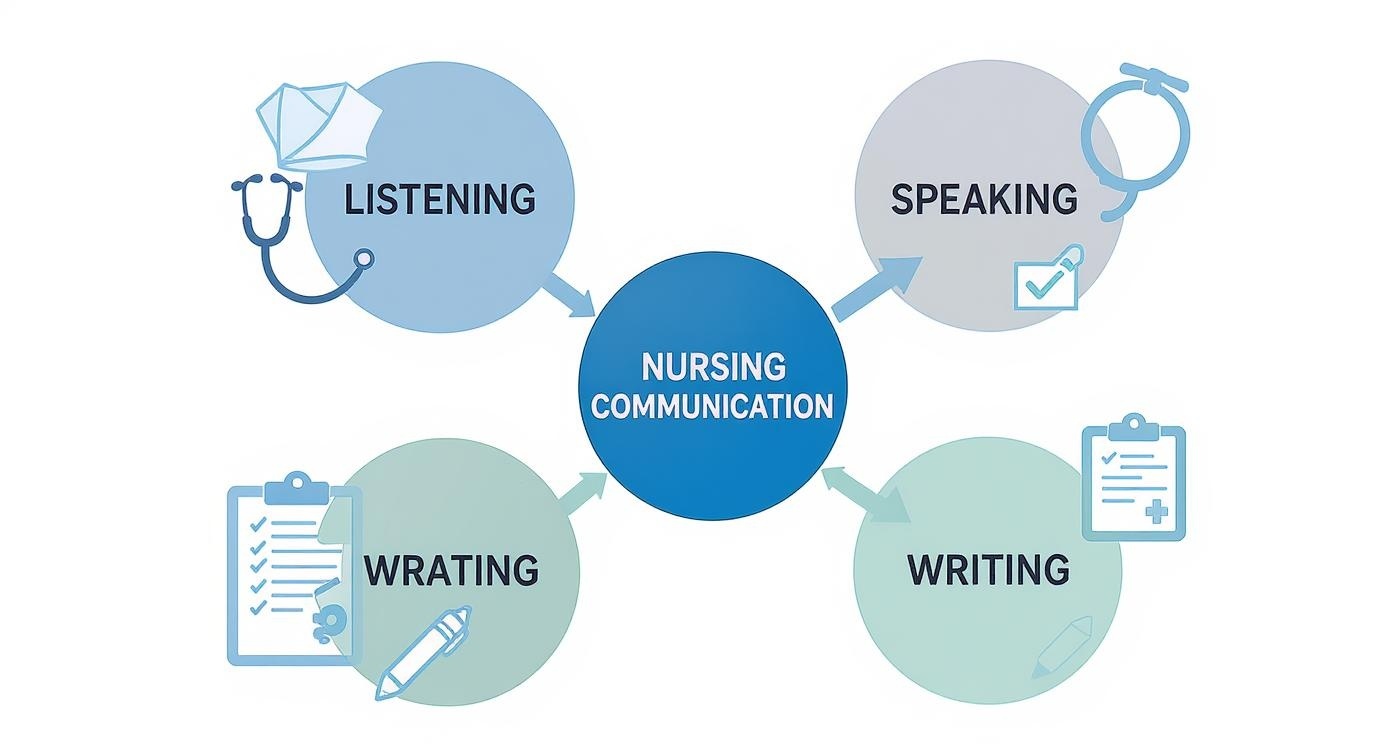
LSRW skills (Listening, Speaking, Reading, Writing) form the cornerstone of effective communication in nursing practice. These fundamental competencies enable nurses to deliver safe, patient-centered care while maintaining professional relationships across interdisciplinary teams.
Why LSRW Skills Matter in Nursing
- Ensure accurate patient assessment and documentation
- Facilitate effective interprofessional collaboration
- Enhance patient safety through clear communication
- Support evidence-based practice through research comprehension
- Enable professional growth and career advancement
Memory Aid: L-S-R-W CARE
Listen with Compassion
Speak with Accuracy
Read for Reflection
Write with Empathy
Listening Skills & Critical Thinking Strategies
Active listening in nursing requires sophisticated communication techniques combined with critical thinking to process, analyze, and respond appropriately to complex healthcare scenarios.
Active Listening Techniques
- • Maintain appropriate eye contact
- • Use nonverbal cues effectively
- • Practice reflective listening
- • Ask clarifying questions
- • Summarize and paraphrase
Critical Thinking Integration
- • Analyze verbal and nonverbal cues
- • Identify underlying concerns
- • Evaluate information credibility
- • Synthesize multiple perspectives
- • Make informed judgments
Listening Skills Assessment Framework
| Skill Component | Novice Level | Competent Level | Expert Level |
|---|---|---|---|
| Attention Focus | Easily distracted | Maintains focus | Selective attention mastery |
| Information Processing | Basic comprehension | Analytical processing | Complex synthesis |
| Response Quality | Simple acknowledgment | Thoughtful responses | Strategic interventions |
Common Listening Barriers in Healthcare
Environmental Barriers:
- • Noise and distractions
- • Time constraints
- • Physical barriers
Personal Barriers:
- • Preconceptions and bias
- • Emotional responses
- • Language differences
Speaking Skills: Oral Reports & Presentations
Effective verbal communication in nursing encompasses patient interactions, professional reporting, and formal presentations. Mastering these skills ensures clear information transfer and professional credibility.
Patient Communication
- • Use simple, clear language
- • Avoid medical jargon
- • Check understanding frequently
- • Show empathy and respect
- • Provide appropriate reassurance
Professional Reporting
- • Follow SBAR format
- • Present facts objectively
- • Prioritize critical information
- • Use precise terminology
- • Confirm understanding
Formal Presentations
- • Structure content logically
- • Use visual aids effectively
- • Engage the audience
- • Practice delivery techniques
- • Handle questions professionally
SBAR Communication Framework
Situation – What is happening?
Background – What led to this?
Assessment – What do you think?
Recommendation – What should we do?
Presentation Excellence Tips
Content Structure:
- • Strong opening hook
- • Clear learning objectives
- • Logical flow of ideas
- • Evidence-based content
- • Memorable conclusion
Delivery Techniques:
- • Confident body language
- • Appropriate voice modulation
- • Eye contact maintenance
- • Interactive elements
- • Time management
Reading Skills & Critical Analysis Strategies
Professional reading in nursing demands sophisticated analytical skills to evaluate research, interpret clinical guidelines, and synthesize evidence for informed decision-making. Critical reading supports evidence-based practice and continuous professional development.
Critical Reading Strategies
- • Preview and predict content
- • Identify author credentials and bias
- • Analyze argument structure
- • Evaluate evidence quality
- • Synthesize multiple sources
- • Question assumptions
Research Article Analysis
- • Assess study methodology
- • Evaluate sample size and validity
- • Analyze statistical significance
- • Consider clinical relevance
- • Identify limitations
- • Apply findings to practice
Reading Comprehension Levels
Level 1: Literal Comprehension
Understanding explicit information, facts, and details directly stated in the text.
Level 2: Inferential Comprehension
Drawing conclusions and making connections between ideas not explicitly stated.
Level 3: Critical/Evaluative Comprehension
Analyzing, evaluating, and critiquing the text’s validity, reliability, and applicability.
CRITICAL Reading Framework
Credibility – Source reliability
Relevance – Clinical applicability
Inference – Logical conclusions
Timeliness – Current information
Implications – Practice impact
Comparisons – Alternative perspectives
Assumptions – Underlying beliefs
Limitations – Study constraints
Professional Writing: Instructions, Letters & Reports
Written communication in nursing requires precision, clarity, and professionalism. From patient documentation to research reports, effective writing ensures accurate information transfer and legal compliance.
Clinical Documentation
- • Objective, factual language
- • Chronological organization
- • Complete and accurate details
- • Proper medical terminology
- • Legal compliance standards
Professional Correspondence
- • Formal tone and structure
- • Clear purpose statement
- • Appropriate salutations
- • Concise message delivery
- • Professional closing
Research Reports
- • Structured format (IMRaD)
- • Evidence-based arguments
- • Proper citation methods
- • Statistical accuracy
- • Ethical considerations
Writing Process Framework
1. Planning
- • Define purpose
- • Identify audience
- • Organize ideas
- • Research content
2. Drafting
- • Write freely
- • Focus on content
- • Maintain flow
- • Include evidence
3. Revising
- • Improve clarity
- • Strengthen arguments
- • Enhance coherence
- • Check accuracy
4. Editing
- • Grammar check
- • Spelling verification
- • Format consistency
- • Citation accuracy
Professional Writing Standards
Content Quality:
- • Accurate and current information
- • Evidence-based statements
- • Logical organization
- • Appropriate depth
Language Mechanics:
- • Proper grammar and syntax
- • Professional vocabulary
- • Consistent formatting
- • Error-free presentation
Error Analysis Framework for LSRW Skills
Systematic error analysis helps identify patterns in communication breakdowns, enabling targeted improvement strategies and enhanced patient safety outcomes.
Common Error Categories
Listening Errors:
Misinterpretation, selective hearing, assumption-based responses
Speaking Errors:
Unclear instructions, inappropriate tone, incomplete information
Reading Errors:
Superficial analysis, bias confirmation, context neglect
Writing Errors:
Inaccurate documentation, unclear language, format inconsistency
Error Prevention Strategies
- • Regular self-assessment and reflection
- • Peer feedback and observation
- • Standardized checklists and protocols
- • Continuous education and training
- • Technology-assisted verification
- • Cultural competency development
Error Analysis Matrix
| Error Type | Root Cause | Impact Level | Prevention Method | Correction Strategy |
|---|---|---|---|---|
| Misinterpretation | Insufficient clarification | High | Active listening training | Immediate verification |
| Incomplete documentation | Time pressure | Medium | Template standardization | Retrospective completion |
| Unclear instructions | Assumption of understanding | High | Teach-back method | Repetition and clarification |
ERROR Analysis Mnemonic
Evaluate the situation
Recognize error patterns
Reflect on causes
Organize improvement plan
Repeat monitoring process
LSRW Integration Strategies
Successful nursing practice requires seamless integration of all four communication skills. Understanding how these skills interconnect and reinforce each other enhances overall professional competency.
Skill Interconnection Model
Listening → Speaking
Active listening informs appropriate verbal responses and builds therapeutic relationships.
Reading → Writing
Critical reading of evidence guides accurate and informed written documentation.
Speaking → Listening
Clear verbal communication encourages open dialogue and feedback reception.
Writing → Reading
Effective writing skills enhance comprehension of complex medical literature.
Integration Best Practices
- • Practice skills simultaneously in real scenarios
- • Use technology to enhance skill development
- • Seek feedback on integrated performance
- • Participate in multidisciplinary rounds
- • Engage in case study discussions
- • Utilize simulation training environments
Progressive Skill Development
Beginner Level:
Focus on individual skill mastery with guided practice
Intermediate Level:
Combine two skills in structured activities
Advanced Level:
Seamless integration in complex clinical situations
Assessment Methods for LSRW Skills
Comprehensive assessment of LSRW skills requires multiple evaluation methods to capture the complexity of communication competence in nursing practice.
Listening Assessment
- • Observation checklists
- • Patient feedback surveys
- • Peer evaluations
- • Self-reflection journals
Speaking Assessment
- • Oral presentations
- • Simulated scenarios
- • Video recordings
- • Standardized patients
Reading Assessment
- • Critical analysis papers
- • Literature reviews
- • Case study interpretations
- • Research critiques
Writing Assessment
- • Documentation reviews
- • Report evaluations
- • Portfolio assessments
- • Peer editing exercises
Competency-Based Assessment Rubric
| Competency Area | Emerging (1) | Developing (2) | Proficient (3) | Advanced (4) |
|---|---|---|---|---|
| Active Listening | Basic attention | Focused listening | Reflective responses | Therapeutic presence |
| Verbal Communication | Simple expression | Clear articulation | Professional delivery | Influential speaking |
| Critical Reading | Basic comprehension | Analytical thinking | Evidence evaluation | Synthesis mastery |
| Professional Writing | Basic documentation | Structured writing | Evidence-based reports | Publication quality |
Assessment Guidelines
Formative Assessment:
- • Regular feedback sessions
- • Peer review activities
- • Self-assessment tools
- • Progress monitoring
Summative Assessment:
- • Comprehensive examinations
- • Portfolio evaluations
- • Clinical performance reviews
- • Capstone projects
Global Best Practices in Nursing Communication
Learning from international healthcare systems provides valuable insights into effective communication strategies and LSRW skill development approaches.
Canada: Interprofessional Education
Canadian nursing programs emphasize collaborative communication through integrated interprofessional education models.
- • Shared learning experiences across disciplines
- • Team-based patient scenarios
- • Standardized communication protocols
- • Cultural safety training integration
Australia: Simulation-Based Learning
Australian nursing education utilizes high-fidelity simulation to develop integrated LSRW skills in realistic clinical environments.
- • Immersive clinical scenarios
- • Real-time feedback systems
- • Multilingual patient interactions
- • Technology-enhanced learning
United Kingdom: Evidence-Based Practice
UK nursing programs integrate critical appraisal skills with clinical communication to support evidence-based decision making.
- • Research literacy requirements
- • Journal club participation
- • Clinical guideline development
- • Quality improvement projects
Scandinavia: Person-Centered Care
Scandinavian countries emphasize person-centered communication approaches in nursing education and practice.
- • Patient narrative methodology
- • Shared decision-making training
- • Empathy development programs
- • Cultural competency standards
Key Success Factors Across International Programs
Educational Innovations:
- • Technology integration
- • Collaborative learning models
- • Competency-based assessment
- • Continuous feedback mechanisms
Practice Integration:
- • Clinical mentorship programs
- • Professional development pathways
- • Quality improvement involvement
- • Research participation opportunities
Conclusion & Additional Resources
Mastering LSRW skills is essential for nursing excellence. These communication competencies serve as the foundation for safe patient care, professional growth, and healthcare team collaboration.
Key Takeaways
- • LSRW skills are interconnected and mutually reinforcing
- • Critical thinking enhances all aspects of communication
- • Regular practice and feedback drive improvement
- • Error analysis prevents communication breakdowns
- • Professional development requires continuous learning
Next Steps for Students
- • Complete self-assessment using provided rubrics
- • Develop personal improvement plans
- • Seek mentorship and feedback opportunities
- • Practice integrated skill scenarios
- • Join professional nursing organizations
Recommended Resources
Professional Organizations:
- • American Nurses Association (ANA)
- • International Council of Nurses (ICN)
- • National League for Nursing (NLN)
- • Sigma Theta Tau International
Educational Resources:
- • PubMed for research literature
- • Cochrane Library for evidence reviews
- • QSEN Institute for quality education
- • Institute for Healthcare Improvement
Remember: Excellence in Communication = Excellence in Care
Your commitment to developing LSRW skills directly impacts patient outcomes and professional success. Keep practicing, keep learning, and keep caring!