Shifting and Transporting of Patients
Comprehensive Nursing Notes for Safe Patient Transfer
Study Time: 45-60 minutes
Difficulty: Intermediate
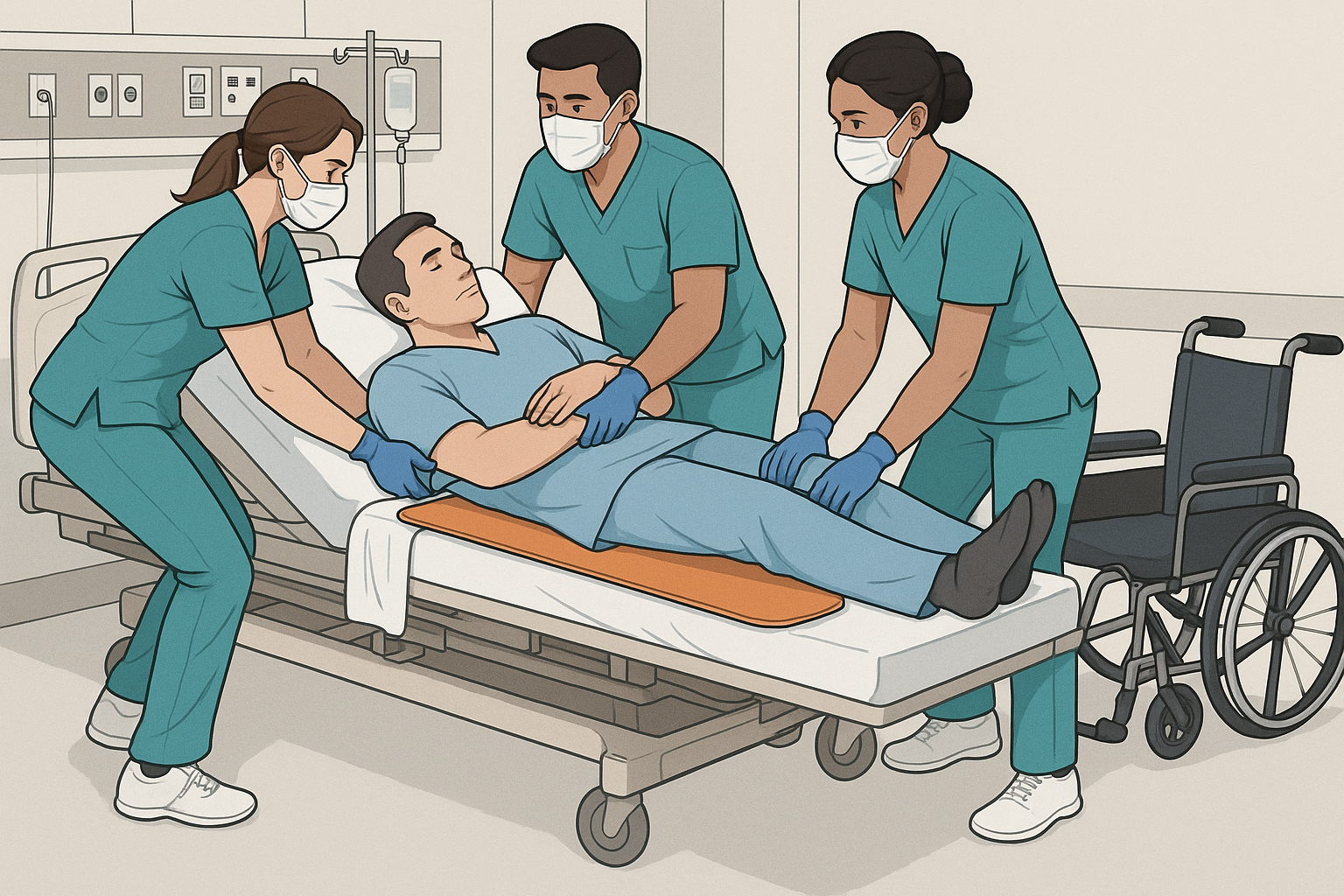
Safe patient transfer requires proper technique, equipment, and teamwork
Table of Contents
1. Introduction and Overview
Patient shifting and transporting is a fundamental nursing skill that involves the safe movement of patients from one location to another within healthcare facilities. This critical competency ensures patient safety, prevents injuries to both patients and healthcare providers, and maintains the continuity of care during transitions.
Why Patient Transfer Matters
- Patient Safety: Prevents falls, injuries, and complications during movement
- Staff Protection: Reduces musculoskeletal injuries among healthcare workers
- Quality Care: Ensures continuity of treatment and monitoring
- Efficiency: Optimizes workflow and resource utilization
- Legal Compliance: Meets regulatory standards and reduces liability
TRANSFER Mnemonic
T – Take time to assess
R – Ready equipment and environment
A – Assess patient’s condition
N – Notify and coordinate team
S – Secure lines and tubes
F – Follow proper body mechanics
E – Evaluate throughout process
R – Record and report
2. Basic Principles of Patient Transfer
Safety First Principles
- Never compromise patient or staff safety for convenience
- Always use appropriate lifting techniques and equipment
- Maintain patient dignity and privacy throughout
- Communicate clearly with patient and team members
Common Transfer Hazards
- Inadequate staffing or preparation
- Improper body mechanics leading to injury
- Equipment malfunction or misuse
- Patient falls or sudden deterioration
Patient Transfer Decision Flow
Patient Transfer Required?
Assess Patient Condition & Mobility
Independent
Minimal assistance
Partial Assist
Equipment + 1-2 staff
Total Assist
Mechanical lift + team
3. Pre-Transfer Assessment
Thorough assessment before any patient transfer is crucial for safety and success. This evaluation determines the appropriate transfer method, equipment needed, and staffing requirements.
Patient Factors
- • Consciousness level and cognition
- • Physical condition and stability
- • Weight and body habitus
- • Mobility limitations
- • Pain level and tolerance
- • Fractures or injuries
- • Skin integrity
- • Cooperation ability
Medical Factors
- • Vital signs stability
- • Respiratory status
- • Cardiovascular condition
- • Spinal precautions
- • Lines, tubes, and drains
- • Monitoring equipment
- • Medication effects
- • Recent procedures
Environmental Factors
- • Space and accessibility
- • Floor surfaces
- • Obstacles and barriers
- • Lighting conditions
- • Equipment availability
- • Staff availability
- • Emergency resources
- • Privacy considerations
ASSESS Mnemonic for Pre-Transfer Evaluation
A – Airway and breathing status
S – Stability of vital signs
S – Spinal and injury precautions
E – Equipment and lines secured
S – Staff and assistance needed
S – Safety measures in place
4. Body Mechanics and Ergonomics
Proper body mechanics are essential to prevent injury to healthcare workers during patient transfers. These principles apply to all transfer activities and should become second nature.
Correct Body Mechanics
Wide Base of Support
Feet shoulder-width apart for stability
Bend at Knees and Hips
Keep back straight, squat to lift
Keep Load Close
Patient or equipment near your body
Avoid Twisting
Turn with your feet, not your spine
Use Leg Muscles
Powerful thigh muscles do the work
Common Mistakes to Avoid
Bending at the waist
Puts excessive strain on lumbar spine
Lifting alone when help is needed
Increases injury risk significantly
Twisting while lifting
Combines compression and rotation forces
Lifting over your head
Compromises balance and control
Ergonomic Considerations
Healthcare workers have injury rates 5 times higher than other industries, primarily due to patient handling. Key ergonomic principles include:
- • Use mechanical lifting devices when available
- • Maintain neutral spine position during all activities
- • Take micro-breaks during prolonged activities
- • Strengthen core muscles regularly
- • Report early signs of musculoskeletal strain
5. Transfer Equipment and Aids
Proper equipment selection and use is crucial for safe patient transfers. Understanding the capabilities and limitations of each device ensures optimal outcomes.
Transfer Boards
Use: Lateral transfers between surfaces
Capacity: Up to 400 lbs
Best for: Cooperative patients with some upper body strength
Precautions: Smooth surfaces only, check weight limits
Mechanical Lifts
Use: Total body lifting and transferring
Capacity: 350-700 lbs depending on model
Best for: Non-ambulatory or heavy patients
Precautions: Proper sling selection, regular maintenance
Gait Belts
Use: Ambulation assistance and support
Capacity: Support only, not lifting
Best for: Mobile patients needing stability
Precautions: Never lift by belt alone
Turning Discs
Use: Pivot transfers and repositioning
Capacity: 300-400 lbs
Best for: Patients who can bear some weight
Precautions: Non-slip surface required
Draw Sheets
Use: Repositioning in bed
Capacity: Multiple staff required
Best for: Bed-bound patients
Precautions: Coordinate movements, protect skin
Stretchers
Use: Transport of supine patients
Capacity: 500-750 lbs
Best for: Inter-department transfers
Precautions: Secure side rails, check brakes
EQUIPMENT Selection Mnemonic
E – Evaluate patient’s mobility level
Q – Question weight and size limitations
U – Understand equipment capabilities
I – Inspect device before use
P – Plan the transfer route
M – Match equipment to patient needs
E – Ensure proper training
N – Never exceed weight limits
6. Transfer Techniques
Mastering various transfer techniques ensures safe and efficient patient movement in different scenarios. Each technique has specific indications and requirements.
Bed to Chair Transfer
Preparation Steps:
- 1. Position chair at 45-degree angle to bed
- 2. Lock bed and chair wheels
- 3. Lower bed to lowest position
- 4. Apply gait belt if appropriate
- 5. Remove or fold footrests
- 6. Assist patient to sitting position
Transfer Process:
- 1. Stand in front of patient
- 2. Patient’s feet flat on floor
- 3. Count “1-2-3” and assist to stand
- 4. Pivot toward chair
- 5. Lower patient slowly into chair
- 6. Position feet on footrests
Lateral Transfer (Bed to Stretcher)
Team Approach (3-4 people):
- 1. Position stretcher parallel to bed
- 2. Raise bed to stretcher height
- 3. Use transfer board if appropriate
- 4. Leader at patient’s head/shoulders
- 5. Second person at torso
- 6. Third person at hips/legs
Execution:
- 1. “On my count, lift and slide”
- 2. Lift patient slightly off bed
- 3. Slide smoothly to stretcher
- 4. Lower patient onto stretcher
- 5. Ensure patient centered
- 6. Raise side rails immediately
Mechanical Lift Transfer
Sling Application:
- 1. Position sling under patient
- 2. Ensure proper alignment
- 3. Check for wrinkles or folds
- 4. Secure all attachment points
- 5. Test connections before lifting
Lifting Process:
- 1. Position lift device properly
- 2. Attach sling to lift arms
- 3. Lift slowly and smoothly
- 4. Guide patient during transfer
- 5. Lower carefully into position
Critical Safety Points
- • Never leave patient unattended during transfer
- • Always lock wheels before transfer
- • Communicate with patient throughout
- • Have emergency equipment nearby
- • Stop immediately if patient feels dizzy
- • Check patient’s response continuously
7. Special Patient Populations
Different patient populations require specialized approaches to ensure safe and appropriate transfers. Understanding these unique considerations prevents complications and improves outcomes.
Critical Care Patients
Special Considerations:
- • Multiple monitoring devices and life support equipment
- • Hemodynamic instability
- • Sedation or decreased consciousness
- • Complex medication drips
Transfer Requirements:
- • Physician approval required
- • Specialized transport team
- • Portable monitoring equipment
- • Emergency medications available
- • Continuous vital sign monitoring
Pediatric Patients
Age-Specific Considerations:
- • Fear and anxiety about movement
- • Different anatomy and physiology
- • Varying cognitive understanding
- • Family involvement needs
Transfer Modifications:
- • Age-appropriate explanations
- • Comfort items allowed
- • Parent/caregiver presence
- • Pediatric-sized equipment
- • Extra safety measures
Elderly Patients
Age-Related Factors:
- • Decreased bone density (osteoporosis)
- • Slower reflexes and balance issues
- • Hearing or vision impairments
- • Medication effects
- • Multiple comorbidities
Safety Modifications:
- • Extra time for transitions
- • Clear, loud communication
- • Fall prevention emphasis
- • Gentle handling techniques
- • Frequent position changes
Trauma Patients
Trauma Considerations:
- • Spinal immobilization requirements
- • Unstable fractures
- • Internal injuries
- • Potential for rapid deterioration
Transfer Protocol:
- • Maintain spinal alignment
- • Log roll technique
- • Cervical collar in place
- • Multiple team members
- • Emergency equipment ready
SPECIAL Populations Mnemonic
S – Size and weight considerations
P – Physical limitations and conditions
E – Emotional and psychological needs
C – Cognitive and communication abilities
I – Individual safety requirements
A – Age-appropriate techniques
L – Legal and family considerations
8. Safety Protocols and Risk Management
Comprehensive safety protocols are essential for preventing injuries and adverse events during patient transfers. These protocols protect both patients and healthcare providers.
Pre-Transfer Safety
- ✓ Obtain physician orders if required
- ✓ Assess patient’s current condition
- ✓ Check for contraindications
- ✓ Verify equipment functionality
- ✓ Ensure adequate staffing
- ✓ Clear pathway of obstacles
- ✓ Position emergency equipment
During Transfer Safety
- ✓ Maintain constant patient observation
- ✓ Monitor vital signs continuously
- ✓ Secure all lines and tubes
- ✓ Use proper body mechanics
- ✓ Communicate throughout process
- ✓ Move slowly and deliberately
- ✓ Be prepared to stop if needed
Post-Transfer Safety
- ✓ Reassess patient condition
- ✓ Ensure proper positioning
- ✓ Check equipment connections
- ✓ Verify safety measures in place
- ✓ Document transfer details
- ✓ Report any complications
- ✓ Follow up as appropriate
Risk Assessment Matrix
| Risk Factor | Low Risk | Moderate Risk | High Risk |
|---|---|---|---|
| Patient Weight | < 150 lbs | 150-250 lbs | > 250 lbs |
| Mobility Level | Independent | Partial assist | Total assist |
| Cognitive Status | Alert/oriented | Mild confusion | Severe confusion |
| Medical Stability | Stable vitals | Monitoring needed | Unstable |
Emergency Response Protocol
STOP
Cease transfer immediately
ASSESS
Check patient condition
STABILIZE
Provide immediate care
NOTIFY
Alert appropriate personnel
9. Complications and Emergency Procedures
Understanding potential complications and having emergency procedures ready is crucial for safe patient transfers. Quick recognition and appropriate response can prevent serious adverse outcomes.
Medical Complications
Cardiovascular Events:
- • Hypotension or hypertension
- • Cardiac arrhythmias
- • Syncope or dizziness
- • Chest pain
Respiratory Issues:
- • Shortness of breath
- • Oxygen desaturation
- • Airway obstruction
- • Ventilator disconnection
Neurological Changes:
- • Altered consciousness
- • Seizure activity
- • Increased intracranial pressure
- • Agitation or confusion
Physical Complications
Patient Injuries:
- • Falls during transfer
- • Skin tears or abrasions
- • Dislocation of joints
- • Fractures (especially elderly)
Equipment Issues:
- • Mechanical lift failure
- • IV line disconnection
- • Catheter displacement
- • Monitor malfunction
Staff Injuries:
- • Back strain or injury
- • Muscle strain
- • Joint injury
- • Repetitive stress injury
Emergency Response Procedures
Immediate Actions:
- 1. Stop the transfer – Halt all movement immediately
- 2. Ensure safety – Secure patient in current position
- 3. Assess patient – Check vital signs and consciousness
- 4. Call for help – Alert appropriate personnel
- 5. Provide care – Address immediate medical needs
- 6. Document – Record incident details
Communication Protocol:
- • Attending physician – Notify immediately
- • Charge nurse – Inform of situation
- • Risk management – Report if injury occurred
- • Family – Update as appropriate
- • Documentation – Complete incident report
RESCUE Emergency Response Mnemonic
R – Recognize the emergency
E – Ensure safety for all
S – Stop transfer immediately
C – Call for appropriate help
U – Utilize emergency protocols
E – Evaluate and document
10. Documentation and Legal Considerations
Proper documentation of patient transfers is essential for legal protection, quality assurance, and continuity of care. Complete and accurate records demonstrate professional accountability and support evidence-based practice.
Required Documentation Elements
Transfer Details:
- • Date and time of transfer
- • Origin and destination locations
- • Method of transfer used
- • Equipment utilized
- • Number of staff involved
Patient Assessment:
- • Pre-transfer condition
- • Vital signs before and after
- • Patient’s response to transfer
- • Any complications or concerns
- • Post-transfer assessment
Communication:
- • Physician orders obtained
- • Report given to receiving unit
- • Family notification
- • Any special instructions
Legal Considerations
Liability Protection:
- • Follow institutional policies
- • Maintain competency certification
- • Document thoroughly and accurately
- • Report incidents promptly
Regulatory Compliance:
- • JCAHO standards adherence
- • OSHA safety requirements
- • State nursing board regulations
- • Facility-specific protocols
Quality Assurance:
- • Participate in quality reviews
- • Learn from incident analysis
- • Contribute to policy updates
- • Support continuous improvement
Sample Transfer Documentation
Date/Time: 03/15/2024 14:30
Patient: Smith, John (Room 304A)
Transfer: Room 304A to Radiology Department
Method: Wheelchair transport
Staff: RN J. Johnson, CNA M. Davis
Pre-transfer VS: BP 128/82, HR 76, RR 18, O2 Sat 97% RA
Patient condition: Alert, cooperative, stable
Equipment: Standard wheelchair, oxygen tank (2L/min)
Complications: None noted
Post-transfer: Patient safely delivered to radiology, report given to rad tech
Signature: J. Johnson, RN
Documentation Best Practices
- • Document immediately after transfer
- • Use objective, factual language
- • Include all relevant details
- • Sign and date all entries
- • Avoid subjective interpretations
- • Record exact times and measurements
- • Note any deviations from normal
- • Keep records secure and confidential
11. Nursing Implementation and Practice
Successful implementation of safe patient transfer practices requires systematic approach, ongoing education, and continuous quality improvement. This section provides practical guidance for incorporating these principles into daily nursing practice.
Implementation Pathway for Nursing Units
Assessment Phase
- • Current practice evaluation
- • Staff competency assessment
- • Equipment inventory
- • Incident review
Planning Phase
- • Policy development
- • Training program design
- • Resource allocation
- • Timeline establishment
Implementation Phase
- • Staff education rollout
- • Practice changes
- • Monitoring systems
- • Continuous feedback
Staff Education Components
Initial Training:
- • Theoretical foundations
- • Equipment demonstrations
- • Hands-on practice sessions
- • Competency validation
Ongoing Education:
- • Annual recertification
- • Case study reviews
- • New equipment training
- • Incident-based learning
Assessment Methods:
- • Written examinations
- • Practical demonstrations
- • Peer evaluations
- • Patient outcome measures
Quality Improvement Metrics
Patient Safety Indicators:
- • Fall rates during transfers
- • Patient injury incidents
- • Pressure ulcer development
- • Patient satisfaction scores
Staff Safety Measures:
- • Work-related injury rates
- • Workers’ compensation claims
- • Days lost due to injury
- • Staff satisfaction with training
Process Measures:
- • Equipment utilization rates
- • Compliance with protocols
- • Documentation completeness
- • Response time to transfers
Continuous Improvement Cycle
PLAN
Identify improvement opportunities
DO
Implement changes on small scale
STUDY
Analyze results and outcomes
ACT
Standardize successful changes
Building a Culture of Safety
Creating a sustainable culture of safe patient handling requires:
- • Leadership commitment and support
- • Open communication about safety concerns
- • No-blame reporting of incidents
- • Regular safety rounds and feedback
- • Recognition of safe practices
- • Investment in proper equipment
- • Ongoing staff development
- • Patient and family involvement
12. Key Takeaways and Resources
Essential Points to Remember
- Safety first: Never compromise patient or staff safety for convenience
- Assess thoroughly: Complete evaluation before every transfer
- Use proper equipment: Select appropriate aids for each situation
- Practice good body mechanics: Protect yourself while caring for others
- Communicate effectively: Keep patient and team informed throughout
- Document completely: Record all relevant details for continuity
Additional Learning Resources
Professional Organizations:
- • Association of Safe Patient Handling Professionals (ASPHP)
- • American Nurses Association (ANA)
- • National Institute for Occupational Safety and Health (NIOSH)
Certification Programs:
- • Safe Patient Handling Certification
- • Ergonomics Assessment Training
- • Transfer Trainer Certification
Continuing Education:
- • Online learning modules
- • Professional conferences
- • Peer-reviewed journals
Final Review: SAFE TRANSFER Checklist
S – Safety assessment complete
A – Appropriate equipment selected
F – Full team coordination
E – Environment prepared
T – Transfer executed smoothly
R – Results monitored continuously
A – Assessment post-transfer
N – Notes documented thoroughly
Study Summary
You have completed a comprehensive review of patient shifting and transporting principles for nursing practice.
Concepts Covered
12
Safety Protocols
25+
Equipment Types
6
Mnemonics
7