
Social Stratification in Nursing
Comprehensive Study Notes for Nursing Students
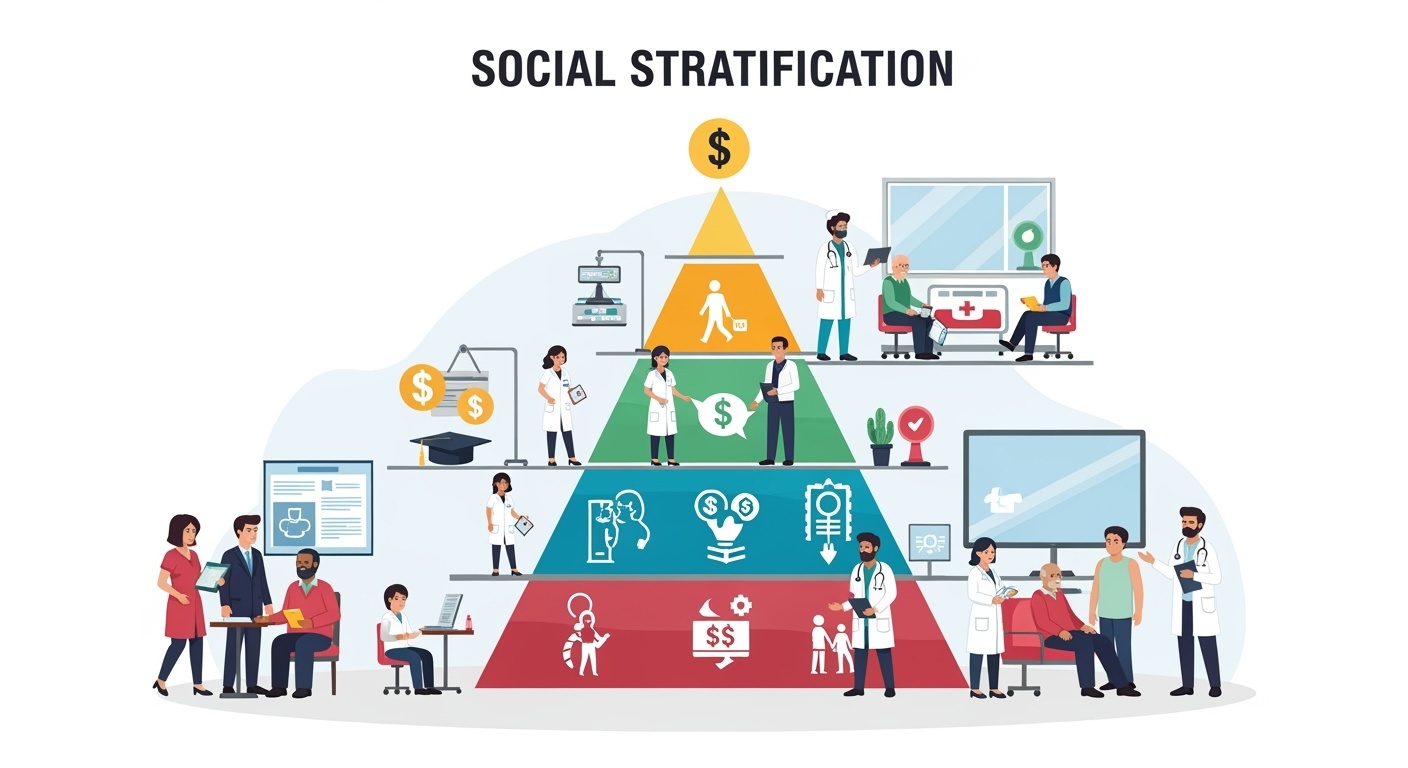
Understanding social hierarchies in healthcare delivery and nursing practice
Learning Objectives
Understand the concept and characteristics of social stratification
Analyze the Indian caste system and its healthcare implications
Explore class systems and social mobility patterns
Examine racial classification and its health impacts
Apply knowledge to nursing practice and patient care
Develop culturally competent nursing interventions
Introduction to Social Stratification
Definition
Social stratification is the hierarchical arrangement of individuals and groups in society based on various factors such as wealth, power, prestige, race, ethnicity, gender, age, and education. It creates distinct social layers or strata with unequal access to resources, opportunities, and life chances.
Memory Aid: “POWER”
- Prestige – Social status and honor
- Occupation – Job-based social ranking
- Wealth – Economic resources and assets
- Education – Knowledge and qualifications
- Race/Religion – Ascribed characteristics
Characteristics of Social Stratification
Universal
Found in all human societies throughout history, though forms and intensity vary across cultures and time periods.
Social
Based on socially defined categories rather than individual characteristics; creates group-based inequalities.
Hierarchical
Creates vertical ranking systems with upper and lower positions, determining access to resources.
Intergenerational
Often passed down through generations, creating persistent patterns of advantage and disadvantage.
Legitimate
Justified through belief systems, ideologies, and cultural norms that make inequality seem natural or deserved.
Forms of Social Stratification
Slavery
Extreme form where people are owned as property
Caste System
Rigid hereditary system based on birth
Estate System
Feudal system with nobility, clergy, commoners
Class System
Based on economic factors and achievements
Comparison of Stratification Systems
| System | Basis | Social Mobility | Healthcare Implications |
|---|---|---|---|
| Caste | Birth, heredity | Very limited | Segregated healthcare, discrimination |
| Class | Economics, education | Possible but difficult | Insurance-based access, quality variations |
| Race/Ethnicity | Physical characteristics | Individual possible | Racial health disparities, bias in treatment |
| Gender | Sex-based roles | Gradually increasing | Gender-specific health needs, access issues |
Functions of Social Stratification
Functional Perspective (Positive Functions)
Role Allocation
Ensures the most qualified individuals fill important positions in society, including healthcare roles.
Motivation for Achievement
Provides incentives for individuals to work hard, acquire skills, and contribute to society.
Social Integration
Creates shared values and goals that bind society together through common aspirations.
Efficient Resource Distribution
Allocates resources based on contribution and importance of roles to society.
Conflict Perspective (Dysfunctions)
Perpetuates Inequality
Maintains systematic disadvantages for certain groups, limiting their access to healthcare and opportunities.
Wastes Human Talent
Prevents capable individuals from lower strata from contributing fully to society.
Creates Social Conflict
Generates tension, resentment, and conflict between different social groups.
Health Disparities
Leads to unequal health outcomes and access to quality healthcare services.
Nursing Implications of Stratification Functions
- Assessment: Consider social position when assessing patient needs and barriers to care
- Planning: Develop culturally sensitive care plans that address socioeconomic factors
- Implementation: Advocate for equitable healthcare access regardless of social status
- Evaluation: Monitor outcomes across different social groups to identify disparities
- Education: Provide health education appropriate to patient’s social and economic context
Indian Caste System
Historical Origins
The Indian caste system originated over 3,000 years ago during the Vedic period. Initially based on occupation (varna), it gradually became hereditary and rigid. The system was codified in ancient texts and reinforced through religious and social institutions.
Traditional Caste Hierarchy
Characteristics of the Caste System
Hereditary Nature
Caste membership determined by birth and cannot be changed through individual effort or achievement.
Endogamy
Marriage within the same caste group, maintaining caste boundaries across generations.
Occupational Specialization
Traditional occupations associated with specific castes, often passed down through families.
Social Segregation
Physical and social separation between castes in housing, dining, and social interactions.
Ritual Purity
Concepts of cleanliness and pollution that govern inter-caste relationships and interactions.
Hierarchical Ranking
Clear vertical ordering with specific privileges and restrictions for each caste level.
Memory Aid: “HEROES”
- Hereditary – Determined by birth
- Endogamy – Marriage within caste
- Ritual hierarchy – Purity concepts
- Occupational specialization – Traditional jobs
- Exclusion – Social segregation
- Status-based privileges – Unequal rights
Impact of Caste System on Society
Positive Impacts
Occupational Specialization
Developed expertise in specific trades and crafts, preserving traditional knowledge and skills.
Social Organization
Provided structure and order to society, defining roles and responsibilities clearly.
Cultural Preservation
Maintained distinct cultural practices, rituals, and traditions within caste groups.
Group Support System
Provided social security and mutual support within caste communities.
Conflict Reduction
Reduced competition by clearly defining social roles and expectations.
Negative Impacts
Social Inequality
Created systematic discrimination and unequal access to resources, education, and opportunities.
Untouchability
Subjected lower castes to dehumanizing practices and social exclusion.
Limited Social Mobility
Prevented individuals from changing their social status regardless of merit or achievement.
Exploitation
Enabled economic and social exploitation of lower castes by upper castes.
Health Disparities
Created significant differences in health outcomes and access to healthcare services.
Human Rights Violations
Violated basic human dignity and rights, particularly for marginalized communities.
Modern Challenges and Changes
Constitutional Measures
- • Article 15: Prohibition of discrimination
- • Article 17: Abolition of untouchability
- • Reservation policies in education and employment
Social Reform Movements
- • Dalit empowerment movements
- • Inter-caste marriage initiatives
- • Educational awareness campaigns
Persistent Challenges
- • Rural areas maintain traditional practices
- • Occupational segregation continues
- • Health and educational disparities persist
Class System and Social Status
Class System Definition
A class system is a form of social stratification based primarily on economic factors such as income, wealth, and occupation. Unlike caste systems, class systems allow for social mobility through individual achievement, education, and economic success.
Key Components of Social Class
Economic Capital
Income, wealth, assets, property ownership
Cultural Capital
Education, skills, knowledge, cultural competence
Social Capital
Networks, relationships, social connections
Class Structure
Social Status Dimensions
Achieved Status
Status gained through personal effort, education, career success
Ascribed Status
Status assigned at birth, based on inherited characteristics
Master Status
Primary status that dominates other statuses and shapes identity
Class and Status in Nursing Practice
Patient Assessment Considerations
- • Evaluate socioeconomic status impact on health
- • Assess access to healthcare resources
- • Consider educational level for health teaching
- • Identify social support systems
- • Recognize cultural capital differences
Intervention Strategies
- • Adapt communication to patient’s background
- • Connect patients with social services
- • Advocate for equitable care access
- • Provide culturally sensitive education
- • Address health disparities proactively
Social Mobility
Definition
Social mobility refers to the movement of individuals or groups from one social position to another within the social hierarchy. It represents the ability to change one’s social class, status, or position in society.
Types of Social Mobility
By Direction
Upward Mobility
Movement to a higher social position (e.g., nurse becoming a nurse practitioner)
Downward Mobility
Movement to a lower social position (e.g., job loss, economic recession)
Horizontal Mobility
Movement within the same social level (e.g., changing specialties in nursing)
By Timeframe
Intragenerational
Mobility within an individual’s lifetime
Intergenerational
Mobility between generations (parents to children)
Exchange Mobility
Some move up while others move down, maintaining overall structure
Factors Affecting Social Mobility
Education
Primary pathway for upward mobility
Occupation
Career choices and professional growth
Social Networks
Connections and opportunities
Economic Factors
Market conditions and policies
Memory Aid: “CLIMB”
- Connections – Social networks and relationships
- Learning – Education and skill development
- Initiative – Personal effort and motivation
- Merit – Talent and abilities
- Barriers – Overcoming structural obstacles
Social Mobility in Nursing Career Pathways
Entry Level → CNA/CMA
Basic healthcare training, entry-level positions
Licensed Practical Nurse (LPN)
Additional training, expanded scope of practice
Registered Nurse (RN)
Associate or Bachelor’s degree, professional practice
Advanced Practice → MSN/DNP
Specialized roles: NP, CNS, CRNA, CNM
Race: Concept and Classification
Concept of Race
Race is a social construct used to categorize people into groups based on perceived physical characteristics such as skin color, facial features, and hair texture. While biologically insignificant, race has profound social, economic, and health implications.
Important Note
Modern science recognizes that race is not a valid biological category. There is more genetic variation within racial groups than between them. However, the social reality of race continues to impact health outcomes and healthcare delivery.
Historical Criteria for Racial Classification
Physical Features
Skin color, facial structure, hair texture
Geographic Origin
Continental ancestry and regional heritage
Genetic Markers
Limited genetic variations (scientifically disputed)
Cultural Factors
Language, traditions, and social practices
Major Racial Categories (US Census)
| Racial Category | Population % | Common Health Issues | Healthcare Barriers |
|---|---|---|---|
| White/Caucasian | 72.4% | Heart disease, cancer, diabetes | Generally better access to care |
| Black/African American | 12.6% | Hypertension, diabetes, stroke | Insurance gaps, provider shortages |
| Asian | 5.9% | Hepatitis B, diabetes, depression | Language barriers, cultural stigma |
| Hispanic/Latino | 18.5% | Diabetes, obesity, liver disease | Documentation status, language |
| Native American | 0.9% | Diabetes, substance abuse, accidents | Geographic isolation, underfunding |
Problems with Racial Classification
Scientific Issues
- • No biological basis for race
- • More variation within groups than between
- • Genetic studies show continuous variation
- • Mixed ancestry is common
Social Issues
- • Perpetuates discrimination
- • Creates artificial divisions
- • Oversimplifies human diversity
- • Ignores cultural complexity
Healthcare Issues
- • Masks socioeconomic factors
- • May lead to biased treatment
- • Overlooks individual variation
- • Complicates research interpretation
Modern Approach: Ethnicity vs. Race
Ethnicity
- • Cultural and social identity
- • Shared language, traditions, values
- • Can be chosen or changed
- • More meaningful for healthcare
Race
- • Based on physical appearance
- • Socially constructed categories
- • Generally fixed assignment
- • Limited healthcare relevance
Influence of Class, Caste, and Race on Health
Health Disparities Overview
Social stratification creates systematic differences in health outcomes, access to care, and quality of treatment. These disparities reflect broader patterns of inequality and discrimination in society.
Class-Based Health Impacts
Economic Barriers
Lower income → Limited insurance → Delayed care → Worse outcomes
Environmental Factors
Poor neighborhoods → Pollution, unsafe housing → Higher disease rates
Lifestyle Constraints
Limited resources → Poor diet, less exercise → Chronic diseases
Stress and Mental Health
Financial stress → Depression, anxiety → Physical health problems
Caste-Based Health Impacts
Social Exclusion
Untouchability → Segregated healthcare → Inferior treatment quality
Occupational Hazards
Dangerous traditional jobs → Higher injury/disease rates
Educational Barriers
Limited education → Poor health literacy → Self-care deficits
Discrimination
Provider bias → Suboptimal care → Health disparities
Race-Based Health Impacts
Systemic Racism
Institutional bias → Unequal access → Treatment disparities
Provider Bias
Unconscious prejudice → Pain undertreatment → Diagnostic delays
Cultural Barriers
Language differences → Miscommunication → Poor outcomes
Historical Trauma
Medical mistrust → Avoidance of care → Preventable complications
Specific Health Disparities Data
Mortality Rate Differences
| Condition | Racial Disparity | Class Disparity |
|---|---|---|
| Heart Disease | 30% higher (Black vs White) | 50% higher (Low vs High income) |
| Stroke | 40% higher (Black vs White) | 45% higher (Low vs High income) |
| Diabetes | 60% higher (Black vs White) | 35% higher (Low vs High income) |
| Cancer | 20% higher mortality (Black) | 25% higher mortality (Low income) |
| Infant Mortality | 2.3x higher (Black vs White) | 1.8x higher (Low vs High income) |
Access to Care Issues
Insurance Coverage
Uninsured rates: Hispanic (19%), Black (12%), White (8%)
Provider Availability
Fewer specialists in low-income and minority communities
Geographic Barriers
Rural and urban poor areas have limited healthcare facilities
Transportation
30% of low-income patients report transportation barriers
Mechanisms of Health Disparities
Direct Pathways
Individual Discrimination
Biased treatment by healthcare providers
Institutional Discrimination
Systemic policies that disadvantage groups
Structural Violence
Broader social inequities affecting health
Indirect Pathways
Socioeconomic Status
Income, education, occupation effects
Environmental Factors
Neighborhood conditions and exposures
Behavioral Factors
Lifestyle choices influenced by constraints
Implementation in Nursing Practice
Core Nursing Competencies for Social Stratification
Cultural Competence
- • Awareness of personal biases and assumptions
- • Understanding of patient’s cultural background
- • Adaptation of care practices to cultural needs
- • Respect for diverse health beliefs and practices
Social Justice Advocacy
- • Recognition of health disparities and inequities
- • Advocacy for policy changes to address barriers
- • Support for vulnerable and marginalized populations
- • Collaboration with community organizations
Nursing Process Application
Assessment
Social History
- • Socioeconomic status
- • Educational background
- • Employment status
- • Housing conditions
- • Family structure
Cultural Assessment
- • Language preferences
- • Religious/spiritual beliefs
- • Health practices and beliefs
- • Dietary restrictions
- • Communication styles
Barrier Identification
- • Financial constraints
- • Transportation issues
- • Insurance coverage
- • Previous discrimination
- • Health literacy level
Nursing Diagnoses
Social Determinants-Related
- • Impaired Social Interaction
- • Social Isolation
- • Ineffective Health Maintenance
- • Deficient Knowledge
- • Powerlessness
- • Spiritual Distress
Access-Related
- • Ineffective Health Seeking Behaviors
- • Risk for Delayed Surgical Recovery
- • Noncompliance
- • Compromised Family Coping
- • Risk for Injury
- • Chronic Low Self-Esteem
Planning and Implementation
Individualized Care Planning
Develop culturally appropriate interventions that consider patient’s social context, resources, and constraints.
Resource Coordination
Connect patients with social services, financial assistance, transportation, and community resources.
Education Adaptation
Provide health education appropriate to literacy level, language, and cultural background.
Advocacy Actions
Advocate for policy changes, equitable treatment, and removal of systemic barriers to care.
Evaluation
Outcome Measures
- • Patient satisfaction with care
- • Clinical outcome improvements
- • Adherence to treatment plans
- • Access to needed services
- • Quality of life indicators
Process Evaluation
- • Cultural competence demonstration
- • Effective communication
- • Resource utilization
- • Barrier reduction success
- • Advocacy effectiveness
Specific Interventions by Stratification Type
Class-Based Interventions
- • Financial counseling referrals
- • Medication assistance programs
- • Transportation vouchers
- • Community health worker coordination
- • Sliding fee scale programs
- • Food security assessments
- • Housing stability support
Caste-Based Interventions
- • Anti-discrimination training
- • Culturally sensitive care protocols
- • Community leader engagement
- • Educational outreach programs
- • Traditional healer collaboration
- • Stigma reduction initiatives
- • Empowerment skill building
Race-Based Interventions
- • Interpreter services provision
- • Bias recognition training
- • Diverse staff recruitment
- • Community partnership building
- • Historical trauma awareness
- • Trust-building initiatives
- • Culturally specific programs
Key Takeaways and Study Tips
Essential Concepts to Remember
Social stratification is universal but varies in form
All societies have hierarchies, but they differ in rigidity and criteria
Health disparities are systematic, not random
Patterns of inequality reflect broader social structures
Multiple factors intersect to affect health
Class, race, gender, and other factors combine in complex ways
Nurses have a role in addressing inequities
Professional responsibility includes advocacy and culturally competent care
Study Strategies
Use case studies
Apply concepts to real patient scenarios to deepen understanding
Practice cultural assessments
Develop skills in gathering and using social and cultural information
Review current statistics
Stay updated on health disparities data and trends
Connect theory to practice
Relate classroom learning to clinical experiences
Final Memory Aid: “NURSING CARE”
- Notice social determinants affecting health
- Understand cultural backgrounds and beliefs
- Recognize personal biases and assumptions
- Support equitable access to healthcare
- Individualize care based on social context
- Navigate resource systems effectively
- Generate culturally appropriate interventions
- Collaborate with community partners
- Advocate for policy and system changes
- Respect diversity in all its forms
- Evaluate outcomes across different groups
References and Further Reading
Key Textbooks
- • Giddens, A. (2023). Sociology. 9th Edition. Polity Press.
- • Macionis, J. J. (2023). Sociology. 17th Edition. Pearson.
- • Institute of Medicine. (2012). How Far Have We Come in Reducing Health Disparities? NAP.
- • Braveman, P., & Gottlieb, L. (2014). The social determinants of health. Health Affairs, 33(1), 19-28.
Professional Resources
- • American Nurses Association Cultural Competency Guidelines
- • CDC Office of Minority Health & Health Equity
- • National Institute on Minority Health and Health Disparities
- • The Joint Commission Advancing Effective Communication Standards
Online Learning Resources
- • Think Cultural Health: https://thinkculturalhealth.hhs.gov/
- • National Culturally and Linguistically Appropriate Services Standards
- • Health Resources and Services Administration Cultural Competence Resources
- • Transcultural Nursing Society Educational Materials